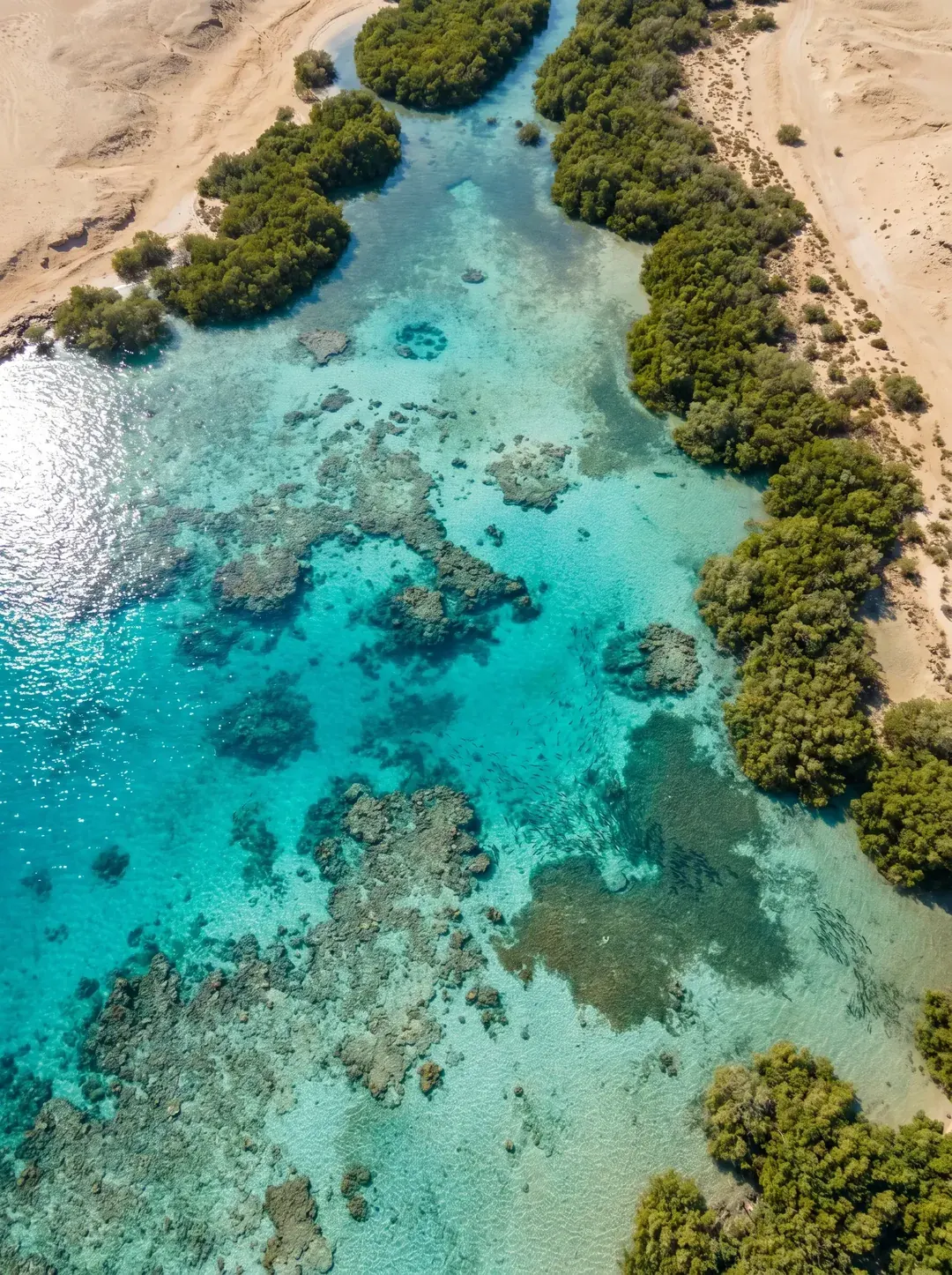
Environmental monitoring in Saudi Arabia is not one market. It combines monitoring of facilities' compliance with environmental standards, overseen by the National Center for Environmental Compliance (NCEC); monitoring of wildlife and habitats in protected areas, overseen by the National Center for Wildlife (NCW); and the monitoring programmes run by the Royal Reserves and the giga-projects. This guide sets out the legal framework, who monitors what, and who commissions the work, based on official texts.
Key facts
- Core law: the Environmental Law, issued by Royal Decree M/165 of 19/11/1441 AH.
- Facility compliance and air, water and coastal quality: the National Center for Environmental Compliance.
- Wildlife and habitats in protected areas: the National Center for Wildlife.
- Protected areas: 18.1% of land and 6.49% of sea (September 2024), with a 30% target by 2030.
The legal framework: the Environmental Law
The Environmental Law was issued by Royal Decree M/165 of 19/11/1441 AH (9 July 2020) and took effect 180 days after its publication in Umm Al-Qura. Its provisions on monitoring include:
- Article 3: no environmental activity, or activity with an environmental impact, may be carried out without a permit or licence.
- Article 8: permit and licence holders must set up programmes and devices to detect, measure and monitor environmental quality, give the competent authority periodic data and reports on emissions, and submit environmental audits. The competent authority decides which activities are covered.
- Article 47: implementing regulations are to govern, among other things, compliance monitoring, noise monitoring, environmental impact assessment, environmental audit and the release of environmental data.
Who monitors what?
| Body | What it monitors | Reference |
|---|---|---|
| National Center for Environmental Compliance | Compliance of development activities with environmental rules and standards; air, water, soil and coastal quality; noise and light pollution. | NCEC website |
| National Center for Wildlife | The status of wildlife and habitats in protected areas, biodiversity data, a database of degraded habitats, and approval of reserve management plans. | Protected Areas Implementing Regulation |
| Both centres, at sea | NCEC carries out periodic marine and coastal pollution monitoring; NCW monitors wildlife and habitat indicators. | Sustainable Management of the Marine and Coastal Environment Regulation |
NCEC operates an air-quality network of 240 monitoring stations, according to King Abdullah University of Science and Technology (KAUST) when it announced a partnership with the centre in May 2025.
The Protected Areas Implementing Regulation requires an NCW permit for any activity inside a protected area, scientific research included, and requires research results to be shared with the centre.
What facilities must do
Under the Implementing Regulation for Environmental Permits to Establish and Operate Activities (15/11/1442 AH):
- Activities fall into three categories by impact: category 1 submits an environmental management plan; categories 2 and 3 submit an environmental impact assessment for the centre's approval.
- Impact assessments, and the analyses, tests and environmental measurements in them, are submitted through a service provider licensed by the centre.
- The centre requests and reviews self-monitoring reports during construction and operation.
- Category 2 and 3 activities submit an environmental audit every three years when renewing their operating permit.
The Air Quality Implementing Regulation (24/9/1442 AH) governs emissions monitoring at stationary sources and ambient air-monitoring networks.
Who commissions biodiversity monitoring?
- The protected-area system: NCW launched the Protected Areas System Plan in September 2024, when the Kingdom had 36 protected areas covering 18.1% of land and 6.49% of sea. The Saudi Green Initiative targets protecting 30% of land and sea by 2030 and lists ongoing monitoring and evaluation among its actions.
- The Royal Reserves: eight reserves, each with its own development authority, relying on field monitoring programmes. One example is a network of more than 100 wildlife cameras in Prince Mohammed bin Salman Royal Reserve, according to its development authority.
- Giga-projects: NEOM describes a long-term monitoring programme using camera traps, satellite tracking collars and drone imagery.
- Reintroduction programmes: every release of oryx, gazelles and other species needs post-release monitoring to show whether the animals survive and breed. See examples in the King Khalid Royal Reserve guide.
Market size
No official body publishes the size of Saudi Arabia's environmental monitoring market. IMARC Group, a market-research firm, estimates it at about USD 229 million in 2025 and expects about USD 379 million by 2034. This is a commercial estimate with no published method, and it focuses on monitoring instruments and equipment rather than studies and biodiversity monitoring programmes.
The Rasmala team's experience
The Rasmala team works on environmental monitoring from the biodiversity and protected-area side, as part of the strategies and management plans our experts have prepared for several Royal Reserves.
How we can help
- Environmental management and monitoring: monitoring indicators, remote-sensing and field-data protocols, state-of-environment reports, decision-support dashboards, and capacity building for monitoring teams.
- Nature and biodiversity conservation: biodiversity baselines, and reintroduction and release plans.
- Nature reserve management: management plans, and management-effectiveness assessment (METT).
Guide to Saudi Arabia's Royal Reserves · King Abdulaziz Royal Reserve
Sources
- Environmental Law, Royal Decree M/165 of 19/11/1441 AH, English translation by the Ministry of Investment — misa.gov.sa
- Implementing Regulation for Environmental Permits to Establish and Operate Activities, 15/11/1442 AH, Umm Al-Qura — uqn.gov.sa
- Air Quality Implementing Regulation, 24/9/1442 AH, Umm Al-Qura — uqn.gov.sa
- Sustainable Management of the Marine and Coastal Environment Regulation, Umm Al-Qura — uqn.gov.sa
- Protected Areas Implementing Regulation, Umm Al-Qura — uqn.gov.sa
- National Center for Environmental Compliance, environmental quality monitoring — ncec.gov.sa
- KAUST, partnership on air-quality forecasting, 14 May 2025 — kaust.edu.sa
- National Center for Wildlife, Protected Areas System Plan launch, 10 September 2024 — ncw.gov.sa
- Saudi Green Initiative, protecting land and sea — sgi.gov.sa
- Prince Mohammed bin Salman Royal Reserve Development Authority, wildlife camera traps — pmbsrr.gov.sa
- Arab News, NEOM's long-term monitoring programme, 25 October 2025 — arabnews.pk
- IMARC Group, Saudi Arabia environmental monitoring market (commercial estimate), January 2026 — imarcgroup.com
Sources checked on 23 October 2026. The Arabic text of laws and regulations prevails, and regulations can be amended, so check Umm Al-Qura and the competent centre's website before relying on any provision.